

You are scrolling through Facebook. It is 10 p.m., you are half-watching something on television in the background, and then — an ad stops you cold. A sharp graphic tee, a confident model, copy that speaks directly to you, and a button that almost dares you not to click. You click. You buy.
That moment is not an accident. It is the result of careful creative decisions, audience strategy, and an understanding of exactly what makes Facebook one of the most powerful platforms for selling apparel in 2026.
The global fashion e-commerce market crossed $1 trillion in 2025, and the competition for attention on Meta has never been fiercer. Yet t-shirt brands — from billion-dollar giants to scrappy independent labels — are still generating extraordinary returns from Facebook ads. The difference between the brands winning and the ones burning through budget? The quality and intention behind their creative.
In this post, we break down ten of the most effective Facebook t-shirt ad approaches you can find in 2026. We have studied what the top brands do, why certain ad styles outperform others, and what you can take from each example and apply to your own campaigns — whether you are selling custom tees on Shopify or scaling a DTC apparel brand to seven figures.
| Quick Context: Why Facebook Still Wins for T-Shirt Brands in 2026
• 74% of fashion shoppers discover new products through social media • Video ads increase purchase intent by up to 2.5x compared to static images • Retargeting campaigns improve ROAS by 3x–8x for apparel brands • The average CPC for apparel on Facebook sits around $1.07 — relatively affordable for high-margin products like graphic tees • Meta’s 3.48 billion daily active users mean your ideal customer is almost certainly on the platform |
Why Facebook Is Still the Best Platform for T-Shirt Ads in 2026
Before we get into the examples, let us address the question that comes up every year: is Facebook advertising still worth it for apparel brands?
The short answer is yes — but the strategy has matured. The days of throwing up a simple product photo and watching sales roll in are over. In 2026, the brands winning on Facebook understand that the platform is not a billboard. It is a discovery engine, a storytelling medium, and a retargeting machine all in one.
What makes Facebook particularly powerful for t-shirt advertising specifically?
- People do not search for t-shirts the way they search on Google. They scroll into them. Facebook and Instagram are built for this kind of passive discovery, and the algorithm is remarkably good at showing your designs to people who are predisposed to love them.
- Fashion is emotional. A t-shirt is not just cotton and ink — it is identity, humour, belonging, and self-expression. Facebook’s format allows you to sell that story, not just the product.
- The targeting capabilities — interest-based, lookalike, and now Advantage+ AI-driven — allow small brands to reach exactly the right people without wasting money on irrelevant audiences.
- The retargeting ecosystem on Meta is unmatched. Someone who viewed your tee yesterday and did not buy can be brought back today with a slightly different angle, a review, or a limited-time offer.
Now, let us get into the good stuff.
The Top 10 Facebook T-Shirt Ad Styles That Drive Real Sales
Note: The brands featured below represent approaches you can study and draw inspiration from. We have analysed their ad strategies, creative choices, and the tactics that make each approach effective. Use these as a creative playbook for your own campaigns.
| #1 — Adidas — The Performance Story Ad
“Built for movement. Made for you.” |
|
| Ad Format | Short-form video (15–30 seconds) + Reels format, vertical 9:16 ratio, bold product close-ups |
| Why It Works | Adidas does not sell fabric. It sells the feeling of being capable. Their Facebook t-shirt ads consistently use dynamic visuals of athletes in motion, with the product almost incidental to the story. By the time you see the “Shop Now” CTA, you are already emotionally invested. The ad does not tell you the tee is good. It shows you a version of yourself that you want to become. |
| Key Tactics |
|
| Pro Tip | Aspiration sells better than specification. Do not tell your audience what your t-shirt is made of in a video ad. Show them who they become when they wear it. Save the fabric specs for the product page. |

| #2 — Carhartt — The Blunt Offer Ad
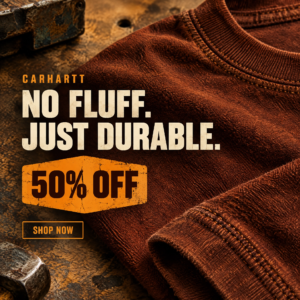
“No fluff. Just durable. 50% off.” |
|
| Ad Format | Static image with text overlay, close-up product shot, square 1:1 format for feed |
| Why It Works | Carhartt’s Facebook ads are almost aggressively un-flashy, and that is exactly why they work. A close-up of the fabric, a price slash in bold, and a no-nonsense headline. The brand knows its audience does not want lifestyle photography and aspirational copy — they want to know the shirt is tough and the price is right. This ad is a masterclass in knowing your customer and refusing to dilute your message for anyone else. |
| Key Tactics |
|
| Pro Tip | A strong discount ad only works if the creative matches the offer. If your ad shows a luxury lifestyle but the headline says ‘50% off’, there is a disconnect. Carhartt’s genius is total consistency between visual, copy, and offer. |
| #3 — Uniqlo — The Everyday Versatility Ad
“For every version of your day.” |
|
| Ad Format | Carousel format showcasing multiple outfit combinations from one core t-shirt |
| Why It Works | Uniqlo sells the idea that their t-shirts are not special occasion items — they are the foundation of a wardrobe. Their Facebook ads lean into this with carousel formats that show the same tee styled across different contexts: casual morning, work-from-home, evening out. They also use real customer testimonials as social proof within the ad copy itself, which builds trust without looking like a branded production. |
| Key Tactics |
|
| Pro Tip | If your t-shirt can be worn multiple ways, show it. A carousel that tells a visual story of versatility converts better than a single product shot because it pre-answers the buyer’s question: ‘When would I actually wear this?’ |

| #4 — Rogue American Apparel — The Values Ad
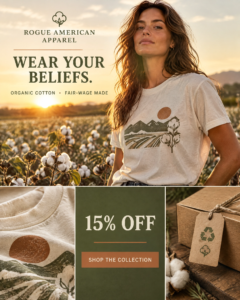
“Wear your beliefs.” |
|
| Ad Format | Single image with cause-driven copy and eco-credential callouts, lifestyle photography |
| Why It Works | In 2026, a growing segment of apparel buyers actively researches the ethics of the brands they purchase from. Rogue American Apparel taps directly into this with ads that lead with sustainability credentials — organic cotton, fair-wage production, eco-friendly packaging. But they do not make it feel like homework. The creative is beautiful, the copy is warm and confident, and the discount offer at the bottom makes it commercially compelling as well as values-aligned. |
| Key Tactics |
|
| Pro Tip | If your brand has an ethical angle — sustainable materials, local manufacturing, charitable giving — put it in your ad. In 2026, this is not a niche play. A significant portion of fashion buyers actively prefer brands that share their values, and Meta’s targeting can find them. |
| #5 — Mott and Bow — The Fit Confidence Ad
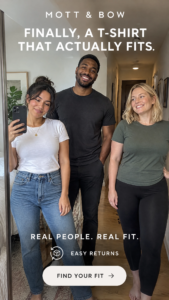
“Finally, a t-shirt that actually fits.” |
|
| Ad Format | UGC-style video featuring real customers of different body types, unscripted feel |
| Why It Works | Fit anxiety is the single biggest reason people abandon t-shirt purchases online. Mott and Bow have built their entire Facebook ad strategy around eliminating that anxiety. Their ads feature real people — different heights, builds, and body types — all talking about finally finding a tee that fits properly. It feels like an honest conversation between friends, not a brand advertisement. The result is an unusually high trust response from viewers who recognise themselves in the people on screen. |
| Key Tactics |
|
| Pro Tip | Your ad should answer the biggest objection your customer has before they voice it. For t-shirts, that objection is almost always fit. Show real bodies, give model measurements, and mention your return policy. Remove doubt before it forms. |
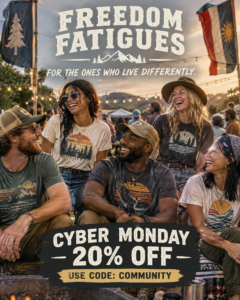
| #6 — Freedom Fatigues — The Community Celebration Ad
“For the ones who live differently.” |
|
| Ad Format | Lifestyle video featuring real customers in real environments, event-tied promotional offer |
| Why It Works | Freedom Fatigues runs ads that feel less like advertising and more like an invitation. By featuring real customers rather than polished models, and by tying ads to cultural moments (Cyber Monday, Independence Day, community events), they create a sense of belonging rather than a sales pitch. A promotional code in the ad gives viewers something tangible to act on, while the lifestyle imagery makes them want to be part of the community the brand represents. |
| Key Tactics |
|
| Pro Tip | Tie your ad to a moment — a holiday, a cultural event, a season. Seasonal relevance dramatically improves click-through rates because the ad feels timely rather than generic. Combine with a promotional code and you have a recipe for strong short-term conversions. |
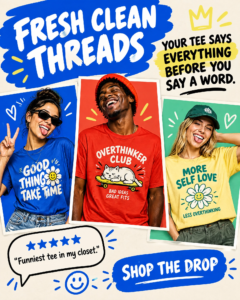
| #7 — Fresh Clean Threads — The Personality-First Ad
“Your tee says everything before you say a word.” |
|
| Ad Format | Bold graphic-led carousel showing multiple design options, pop-culture and humour-driven copy |
| Why It Works | Fresh Clean Threads has cracked the code for selling to younger, personality-driven buyers on Facebook. Their ads lean hard into bold, graphic-led visuals and copy that is deliberately funny and self-aware. They combine product showcases with real customer reviews and discount offers, creating a creative that is entertaining to look at, trust-building, and commercially compelling all at once. The message is simple: wear who you are. |
| Key Tactics |
|
| Pro Tip | Do not be afraid to have a personality in your ads. In a feed full of polished lifestyle photography, a genuinely funny or surprising piece of copy can stop a scroll better than any production budget. Know your audience’s sense of humour and use it. |
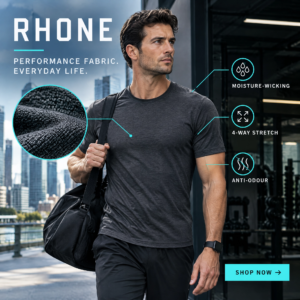
| #8 — Rhone — The Technical Detail Ad
“Performance fabric. Everyday life.” |
|
| Ad Format | Product-focused static image with fabric detail callouts, text overlay with key specifications |
| Why It Works | Rhone targets a specific audience: active professionals who want clothes that work as hard as they do. Their Facebook ads take a refreshingly transparent approach by actually telling the viewer what the fabric does — moisture-wicking, stretch-recovery, anti-odour, 4-way stretch — and then showing it in action. This specificity is what converts their audience, because for a buyer who genuinely cares about performance, specifics are more persuasive than aesthetics. |
| Key Tactics |
|
| Pro Tip | Know what your customer actually cares about and speak to that directly. Rhone does not try to sell everyone — they sell specifically to people who care about fabric performance. That focus makes their ads highly relevant and their conversion rates strong. |
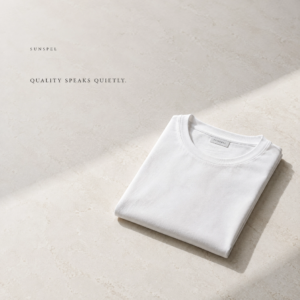
| #9 — Sunspel — The Minimalist Luxury Ad
“Quality speaks quietly.” |
|
| Ad Format | Minimalist static image, white space dominant, logo-forward, almost no body copy |
| Why It Works | Sunspel’s Facebook ads are a fascinating case study in confidence. They do almost nothing that conventional ad wisdom recommends — minimal copy, no offer, no CTA button visible — and yet they work brilliantly with their target audience. The reasoning is simple: the people who buy Sunspel already know what they value. The ad does not try to persuade. It simply announces, with impeccable taste, that the brand exists. For luxury positioning, restraint is the creative. |
| Key Tactics |
|
| Pro Tip | If you are positioning your t-shirt brand at the premium end of the market, resist the urge to overcrowd your ads with offers and copy. Restraint is a creative signal. Sunspel’s minimalist ads say ‘we do not need to shout because we are confident in what we offer’ — and that confidence converts with the right audience. |
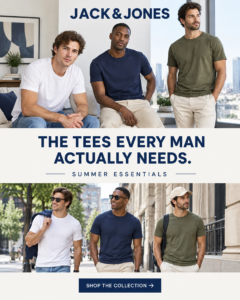
| #10 — Jack & Jones — The Modern Wardrobe Essentials Ad
“The tees every man actually needs.” |
|
| Ad Format | Clean product-on-model photography, collection-focused carousel, seasonal styling copy |
| Why It Works | Jack & Jones appeals to men who want to look sharp without overthinking it. Their Facebook ads solve this problem directly — showing how their t-shirts anchor a modern wardrobe with minimal effort. The creative is clean, the copy is practical, and the carousel format allows them to show a full seasonal collection in a single ad unit. They target men who are not necessarily fashion-conscious but do want to look put-together, and every creative decision speaks to that specific aspiration. |
| Key Tactics |
|
| Pro Tip | Not every buyer thinks of themselves as a fashion person. Ads that solve a practical problem — ‘you need tees that make you look good, here they are’ — convert well with audiences who are not motivated by trends but do care about their appearance. Speak to the outcome (looking sharp) not the fashion identity (being stylish). |
What All 10 of These Ads Have in Common
Looking across these ten examples, a clear pattern emerges. The brands winning on Facebook with t-shirt ads in 2026 are not just producing good-looking content. They are making deliberate decisions that directly address the reasons people do not buy.
1. They Answer the Three Silent Questions
Every potential buyer scrolling through Facebook is unconsciously running three checks as they see a t-shirt ad:
- Do I like the style? (Aesthetic fit — will I actually wear this?)
- Will it fit me properly? (Size and fabric — can I trust the product?)
- Is it worth it right now? (Price, offer, trust — is this the right moment to buy?)
The best Facebook t-shirt ads address all three of these within the first few seconds. They do not rely on the landing page to do the heavy lifting. The ad itself removes enough doubt to get the click.
2. They Match Format to Message
The brands in this list do not pick an ad format at random. They choose the format that best serves what they are trying to communicate.
- Video is used when movement, fit, or emotion is the key message
- Carousel is used when variety, versatility, or a full collection needs to be shown
- Static image is used when a single powerful visual or a bold offer is the hook
- UGC-style content is used when trust and authenticity are the primary conversion drivers
3. They Have One Job Per Ad
The biggest mistake t-shirt brands make on Facebook is trying to do too much in a single ad. The examples above succeed because each one has a single, clear objective: generate awareness, deliver an offer, build trust, or drive a click. When you try to achieve all four simultaneously, you achieve none of them.
4. They Are Built for Mobile First
Over 98% of Facebook users access the platform on mobile. Every ad in this list is designed to be consumed on a 6-inch screen, often with the sound off, while the viewer is doing something else. The visuals are large and clear, the copy is short and scannable, and the hook lands in the first two seconds.
The Best Facebook Ad Formats for T-Shirt Brands in 2026
The format you choose is as important as the creative within it. Here is how the major formats perform for t-shirt brands specifically:
Short-Form Video and Reels (15–30 Seconds)
Video now dominates Facebook performance for fashion brands. Short-form vertical video (9:16 ratio) achieves 2.1x higher engagement rates and 34% lower cost-per-acquisition than static images in 2026. For t-shirt ads specifically, video excels at showing fit, fabric movement, and lifestyle context in a way static photography simply cannot match. The hook must land in the first two seconds — everything else follows from there.
Carousel Ads
Carousels are having a comeback in 2026. They perform 40% better than single static images for e-commerce, and for t-shirt brands, they are particularly useful for showing multiple colourways, demonstrating styling versatility, or telling a short visual story. The interactive element — swiping through cards — creates engagement that improves algorithm distribution.
UGC-Style Content
User-generated content — or content designed to look like it — is currently the highest-converting creative format across most fashion verticals. Brands are increasingly producing content that has the authentic, slightly rough feel of a real customer’s video, even when it is professionally shot. The psychology is simple: it feels like a recommendation from a real person rather than an advertisement.
Dynamic Product Ads (DPA)
Dynamic product ads pull items from your catalogue and show personalised ads based on what specific users have viewed, added to cart, or engaged with. For t-shirt brands with multiple SKUs, DPAs are the engine of high-ROAS retargeting. If someone looked at your black graphic tee but did not buy, they see that exact product again — sometimes with a review or a small incentive added.
Writing Facebook Ad Copy That Actually Sells T-Shirts
Most t-shirt brands spend 90% of their creative time on visuals and almost no time on copy. That is a mistake. Even in a visual medium, the words in your ad are doing critical work.
The Hook Line
Your first line of copy (the primary text before the “See more” cutoff) needs to do one thing: create enough curiosity or immediate relevance that the viewer pauses. Examples that work:
- “If you have ever bought a t-shirt that shrank, read this.”
- “This is the tee your favourite person is wearing right now.”
- “Soft. Fitted. Actually lasts. (Plus 20% off this week.)”
- “Stop buying tees that go wrong after three washes.”
The hook is not about your brand. It is about the viewer’s experience or problem.
The Body Copy
Keep it short. Address one key benefit or solve one key objection. If you are running a video ad, the copy reinforces what the viewer is seeing. If you are running a static image, the copy fills the gap the visual cannot cover.
The CTA
“Shop Now” remains the most effective CTA for direct-response t-shirt ads. Do not overthink it. If you have a specific offer, include it in the CTA area: “Shop Now — 25% off ends Sunday” works significantly better than a generic button.
Targeting That Works for Facebook T-Shirt Ads in 2026
The targeting landscape on Meta has shifted significantly. Here is what is working in 2026:
Broad Targeting First
Counter-intuitive but true: for most t-shirt brands, broad targeting (age, gender, location) now outperforms heavy interest stacking. Meta’s algorithm has enough behavioural data to find buyers within a wide audience — especially if your creative is doing its job of signalling to the algorithm who should see it.
Lookalike Audiences
Build lookalike audiences from your highest-value customer segment — not just any purchasers, but repeat purchasers or buyers above a certain order value. These lookalikes tend to convert at higher rates and with better lifetime value than interest-based audiences.
Retargeting Tiers
Structure your retargeting by intent level:
- Website visitors (broadest, lowest intent) — show your best-performing product ad or a social proof piece
- Product page viewers (medium intent) — show a dynamic product ad of what they viewed, perhaps with a review
- Add-to-cart and checkout abandoners (highest intent) — show a direct offer, easy returns message, or a small incentive
Advantage+ Audiences
Meta’s Advantage+ Audience tool uses AI to optimise targeting in real time. For t-shirt brands with established pixel data and a creative testing system, Advantage+ campaigns are increasingly outperforming manually structured campaigns. Let the algorithm work — your job is to give it great creative to work with.
How Much Budget Do You Need to Start Selling T-Shirts on Facebook?
This is the question every new apparel brand asks, and the honest answer is: less than you think to start, more than you expect to scale.
- Testing phase (finding what works): $10–$50 per day. Enough to gather meaningful creative performance data across 5–7 days.
- Scaling phase (profitable creatives identified): $100–$500 per day, with budget concentrated on your top two or three performing ad sets.
- Full-scale DTC operation: $1,500–$6,000+ per month across prospecting, retargeting, and retention campaigns.
The key principle: never increase budget on a campaign that is not already proving itself. Scale what works. Cut what does not. Refresh creative weekly to prevent ad fatigue.
5 Common Mistakes T-Shirt Brands Make With Facebook Ads
Learning from what fails is as valuable as learning from what succeeds. Here are the five most common errors we see:
1. Running One Ad and Expecting Results
The brands winning on Facebook test 15–25 new creative variants per month. You are not looking for the perfect ad on the first attempt. You are running a systematic process of testing, learning, and scaling what works. One ad is not a campaign — it is a guess.
2. Ignoring the Product Page After the Click
A brilliant ad that leads to a weak product page is a wasted click. The top Facebook t-shirt brands ensure their product pages load fast on mobile, show model measurements, include real reviews, and make the return policy easy to find. If your CTR is strong but your conversion rate is low, the problem is almost certainly after the click.
3. Overcrowding the Ad With Messages
One ad. One message. One action. Every element that you add to an ad beyond your core message dilutes its effectiveness. The best-performing t-shirt ads in 2026 are notable for their restraint — they say one thing clearly and well.
4. Giving Up on Ads Too Early
Facebook ads for t-shirt brands typically need 7–14 days to exit the learning phase before performance data is reliable. Many brands pull ads after 2–3 days of modest results, never giving the campaign the time it needs to optimise. Patience in the early stage, combined with consistent creative testing, is what separates brands that succeed from those that conclude ‘Facebook ads don’t work for us.’
5. Treating Facebook Like a Search Platform
People on Facebook are not looking for your t-shirt. They are scrolling, engaging, and existing on a social platform. Your ad needs to interrupt that scrolling and create a desire the viewer did not know they had. Ads that read like search result listings — “Buy premium graphic tees | Free shipping | 100% cotton” — do not work on Facebook. Ads that tell a story, create an emotion, or solve a recognisable problem do.
Final Thoughts: What You Should Take From These 10 Examples
Facebook advertising for t-shirt brands is not magic, and it is not as complicated as the marketing industry sometimes makes it sound. At its core, it is about understanding your customer, telling them a story that resonates, and making the next step — the click, the visit, the purchase — feel effortless.
The ten brands and ad styles in this post represent ten different approaches to doing exactly that. Adidas sells aspiration. Carhartt sells directness. Uniqlo sells versatility. Mott and Bow sells fit confidence. Each approach works because it is rooted in a genuine understanding of what that specific audience actually cares about.
The question to ask yourself before you run your next Facebook t-shirt ad is not ‘Does this look good?’ It is ‘Does this make the right person stop scrolling and feel something?’ If the answer is yes, you are already ahead of most of the brands competing for the same feed space.
Now go test something.
| Need Help Running Facebook Ads for Your Apparel Brand?
At Glimmers Point LLP, we help clothing and e-commerce brands build Facebook and Meta advertising strategies that drive real sales — not just impressions. From creative strategy to campaign management and reporting, we run the full pipeline. Book a free strategy call: glimmerspoint.com | Info@glimmerspoint.com |
Frequently Asked Questions (FAQs)
Here are the most common questions brands ask when they are starting out with Facebook t-shirt advertising.
Q: What makes a Facebook t-shirt ad successful in 2026?
Three things drive success consistently: relevance, clarity, and trust. Your ad needs to feel immediately relevant to the person seeing it (which comes from targeting and creative alignment), it needs to communicate one clear message without confusion, and it needs to give the viewer enough trust signals — real product photography, reviews, clear return policies — to feel comfortable clicking. Brands that nail all three consistently outperform those chasing trends or production value alone.
Q: Which Facebook ad format works best for selling t-shirts?
In 2026, short-form vertical video (15–30 seconds) delivers the highest engagement and lowest cost-per-acquisition for apparel. Carousel ads perform well for brands with multiple designs or colourways, as they allow a swipeable product gallery within a single ad unit. For retargeting specifically, dynamic product ads (DPAs) are the most efficient tool — they show buyers the exact product they already expressed interest in.
Q: How much should I spend on Facebook ads to sell t-shirts?
For testing and creative discovery, $10–$50 per day is sufficient to gather meaningful data over 7–10 days. Once you have identified creatives that are generating a positive ROAS, scaling to $100–$300 per day per winning campaign is a reasonable next step. Avoid scaling aggressively before your creative has proven itself — scaling a losing campaign just loses money faster.
Q: Should I use broad targeting or interest-based targeting for t-shirt ads?
For most t-shirt brands, broad targeting — defined by age, gender, and location without heavy interest stacking — now outperforms complex interest targeting on Meta. The algorithm has matured to the point where it can identify buyers from behavioural signals better than manual interest selection can. However, for niche t-shirt brands (e.g., targeting fans of a specific subculture, hobby, or cause), interest-based or lookalike audiences built from existing customer data can still provide an edge. Test both and let performance data decide.
Q: What type of creative performs best for t-shirt ads — video or static image?
Video outperforms static images by a significant margin for most apparel brands. Video ads achieve 2.1x higher engagement and 34% lower cost-per-acquisition on average. However, static images still have a role — particularly for clean offer ads (a strong discount with a clear product visual) and for retargeting audiences who already know the product. A healthy Facebook t-shirt advertising account uses both formats, with video driving prospecting and awareness and static images supporting retargeting and offer-based campaigns.
Q: How often should I refresh my Facebook t-shirt ad creative?
Top-performing apparel brands review creative performance weekly and pause any ad where frequency exceeds 3.0 for prospecting audiences — a signal that the same audience is seeing the ad too often, causing fatigue and rising CPMs. In practice, this means adding 2–4 new creative variants per campaign per week. You do not need completely new concepts each time — variations in hook, format, or offer on a proven concept can extend the life of a winning creative significantly.
Q: Can small t-shirt brands compete with big names like Adidas on Facebook?
Absolutely — and in many cases, smaller brands have a structural advantage. Large brands are optimising for global awareness and brand metrics. A small t-shirt brand can hyper-focus on a specific niche audience with a creative that speaks directly and authentically to them. A micro-niche t-shirt brand that truly understands its community will consistently outperform a generic product from a big brand in terms of click-through rates, conversion rates, and return on ad spend. The algorithm rewards relevance, not budget size.
Q: What is the best time to run Facebook t-shirt ads?
Wednesday and Thursday show the strongest average performance for Facebook e-commerce ads in 2026, though this varies significantly by audience and niche. More importantly, for international audiences, your ads should be scheduled around the peak browsing hours of each target region rather than a single global schedule. Run your campaigns for at least a full week before drawing timing conclusions — the algorithm needs time to learn the optimal delivery windows for your specific audience.
Q: Do Facebook t-shirt ads work for print-on-demand stores?
Yes, and print-on-demand brands are actually well-suited to Facebook advertising for a specific reason: they can test many different design concepts as separate ad creatives without holding inventory risk. If a design does not resonate in testing, you lose only the modest ad spend for that test. If it does resonate, you scale. This makes Facebook a very efficient product discovery and validation tool for POD businesses, in addition to being a sales channel.
Q: How do I write Facebook ad copy that actually sells t-shirts?
Start with your customer’s problem or desire, not your product’s features. The most effective t-shirt ad copy opens with something the viewer recognises about their own experience: a frustration (shirts that shrink), a desire (looking effortlessly sharp), or a curiosity (why this tee has 4,000 five-star reviews). Then — briefly — explain why your product solves that problem. Then give them a reason to act now: a limited offer, free shipping, an easy return policy. End with a clear, simple CTA. Keep the whole thing scannable on a mobile screen.