

TL;DR
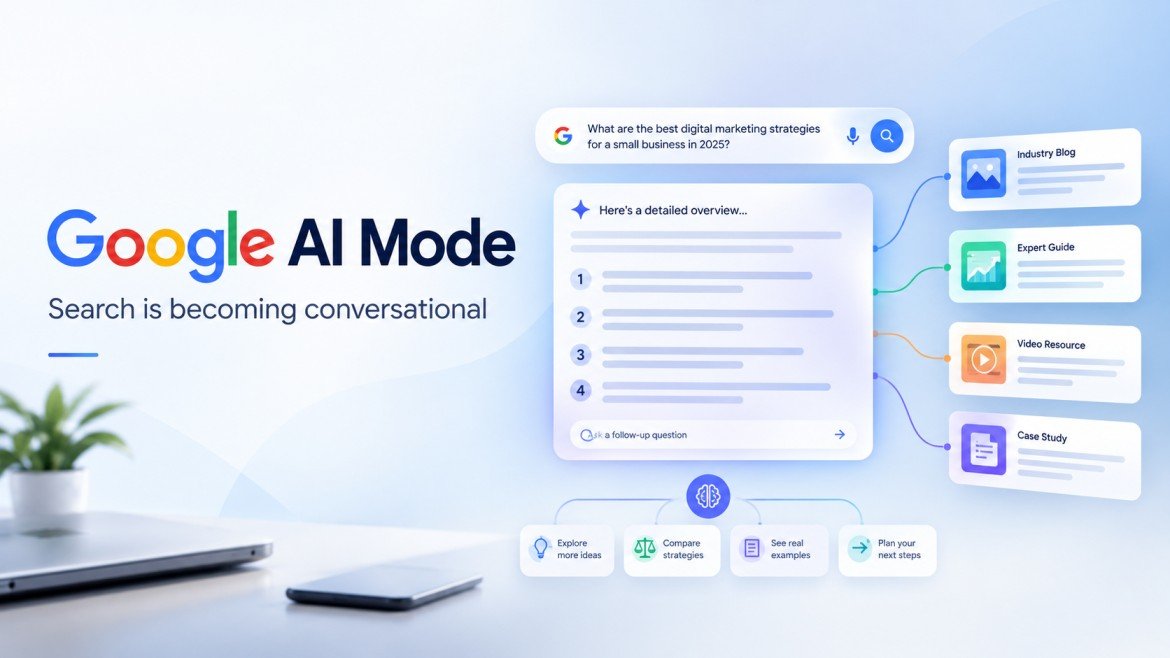
Google AI Mode is a search experience that uses AI. It helps users ask questions, follow up on answers, and find information from many sites on the internet.
SEO does not disappear with AI Mode. Google still says that pages must be easy for Google to read, be technically correct, helpful, and truly useful for people. The biggest shift is how people search. Queries are longer, more precise, and sound like a conversation. Businesses should look at what users want, show expertise, give solid depth on a topic, link inside their own site, and keep technical SEO strong. Do not write for AI. Write for readers so they trust and use what you share today.
Google Search is changing from a place where you type a few keywords and scan through links into something far more conversational. That shift is largely being driven by Google AI Mode. Rather than searching many times for a hard topic users can pose a single detailed question, review the answer, ask more questions, and keep learning without restarting each time.
For businesses and SEO specialists, this creates a question: if Google can answer many questions directly, what will happen to websites and SEO practices, and soon in the future for all. The answer is considerably more interesting than simply saying AI will replace traditional search.
What Is Google AI Mode?
Google AI Mode is an AI search tool that lets users ask questions in chat style and find web data, with rich answers and follow up Google AI Mode. It is designed for searches that may require more than one query to answer fully.
For example, someone might traditionally search: “best SEO strategy for small business.” With AI Mode, that same person might ask: “What SEO strategy should a small business use to generate qualified leads from Google without depending heavily on paid advertising?” The second question gives Google considerably more context — the business type, objective, channel, and limitation all in one query. Instead of simply matching keywords, AI Mode investigates different aspects of the question and brings relevant information together.
Google uses a process called query fan-out, where a complex question is broken into related searches or subtopics to gather information before generating a response. That is one of the biggest functional differences between traditional keyword searching and conversational AI Search.
How Does Google AI Mode Work?
Think of a traditional search journey as: Question → Search results → Website → Answer. AI Mode transforms that into: Complex question → Multiple related searches → AI response → Sources → Follow-up questions → Deeper research.
Importantly, AI Mode still connects users with information from the wider web. Google has continued adding ways for users to discover relevant websites, articles, and original perspectives within its AI Search experiences. So AI Mode is not simply about keeping users inside Google — it is also becoming another channel through which people discover websites.
Imagine someone asking: How can I improve my website’s traffic when competitors already have much more content than I do? There is no clean answer to that question. Google may need to consider search intent:
- content quality signals
- technical SEO factors
- internal linking structure
- topical coverage gaps
- competitor content depth
- website authority
- user experience quality
- long-tail search opportunities
— all as interconnected parts of one complex problem. This is precisely where query fan-out becomes genuinely useful rather than just technically interesting.
Importantly, AI Mode still connects users with information from the wider web. Google has continued adding ways for users to discover relevant websites, articles, and original perspectives within its AI Search experiences. So AI Mode is not simply about keeping users inside Google — it is also becoming another channel through which people discover websites.
Google AI Mode vs AI Overviews vs Gemini
These three terms are often mentioned together in SEO. Each has a distinct meaning worth understanding, on its own.
AI Overviews
It provides an AI-generated summary displayed within standard Google Search results for eligible queries, appearing above the traditional blue-link results and giving users a quick synthesized answer without requiring them to click through to any specific website.
Google AI Mode
It offers a truly chat‑like search journey, letting people ask follow‑up questions, dig into a topic step by step, and keep exploring through conversation instead of ending after a single summary. It is made for long investigations, not for fast one‑time answers, in the modern digital age.
Gemini
This is Google’s broader AI model and product ecosystem. Google uses Gemini technology together with its Search systems to power experiences such as AI Mode, but Gemini extends well beyond Search into other Google products.
A simple way to remember the distinction: AI Overviews deliver AI-generated information within standard Search, AI Mode enables deeper conversational AI Search, and Gemini is the broader AI ecosystem powering both. Google has also been moving toward a more seamless experience between AI Overviews and AI Mode, allowing users to transition naturally from an initial response into deeper exploration.
Why Are AI Mode Searches Different?
One of the most practically important changes for SEO is how people phrase their searches when using AI Mode. Google has reported that people use AI Mode for longer, more complicated, and more nuanced questions. In India, Google has also reported that AI Mode queries can be nearly three times longer than traditional searches — a statistic with significant implications for content strategy.
Compare the search query for SEO agency India with the AI Mode query: What should a growing B2B company look for when choosing an SEO agency India if the main goal is qualified leads rather than just more website traffic? The AI Mode query tells Google what the user wants, where the user wants it, what kind of business the user has, the result the user wants, what the user does not want, and the decision the user is making. Understanding search intent is more important for SEO than counting keywords and repeating them.
How Does Google AI Mode Affect SEO?
AI Mode does not mean traditional SEO is dead. Google’s current guidance confirms that existing SEO best practices remain foundational for its generative AI search experiences. Pages still need to be crawlable, indexable, and eligible to appear in Google Search for any AI-powered experience built on top of it to function.
What is really changing is how businesses should view content. By focusing only on “which keyword to target, ” a smarter question is “what does someone need to know before solving this problem?” This shift emphasizes understanding real user needs over keywords. That shift in thinking can completely transform a content strategy.
1. Focus on the topic, not keyword repetition.
A genuinely useful page should naturally cover the important aspects of a subject. An article about keyword research for e-commerce may discuss buyer intent, commercial vs. Searches, product-page keywords, category-page keywords, long-tail searches, search volume vs. Business value, and how to track results. Repeating the keyword in every paragraph is not necessary. Google’s guidance specifically says websites do not need to create separate pages for every possible query variation.
2. Add something people cannot find everywhere.
If ten sites share the idea with nearly identical details, adding an eleventh copy gives very little benefit. Only original research, first‑hand observations, real case studies, expert explanation, and useful comparisons make a page truly valuable. Google’s generative‑AI search advice stresses unique, non‑commodity content and calls for first‑hand expertise and fresh viewpoints, for readers worldwide, and to improve engagement today.
3. Build genuinely connected content.
A single article cannot answer every meaningful question around a competitive subject. A business building SEO expertise can create content on SEO basics, keyword research, technical SEO, on-page optimization, internal linking, local SEO, ecommerce SEO, content strategy, and AI Search. Each page links to others where helpful. This helps visitors find information without going back to Google, showing deep topical authority and strong user value.
4. Keep the technical foundation strong.
AI Search does not make technical SEO less important. Google says its generative AI uses content from its Search systems. Crawlability, indexing, page experience, and clear content structure still matter a lot. These factors help Google find and use information effectively. Without them, AI features may not work well. Keeping content accessible supports results. There is also no special markup that guarantees inclusion in AI Mode responses — the same technical fundamentals have always been and remain the baseline.
Can Websites Appear in Google AI Mode?
Websites can be used as sources in Google’s AI Search. May bring real referral traffic. But business owners should know: just because a site is eligible doesn’t mean it will appear in every AI answer. Visibility depends on factors beyond just being listed. Not all searches will show your site even if you’re qualified.
Google’s documentation is clear that even when a page follows all relevant requirements and best practices, Google does not guarantee it will crawl, index, or serve that page in any particular context. This is why businesses should be carefully doubtful of claims like “rank number one in AI Mode,” “guaranteed AI citations,” or ” GEO formula.” No reliable shortcut gives those results. Google tells website owners to be careful about third-party services that promise AI-search placement results. Always question these promises.
Will Google AI Mode Reduce Website Traffic?
This is the question most website owners genuinely care about most. AI-generated answers can satisfy some searches without requiring a click — that is true. But that does not mean every search now ends without visiting a website.
Many searches involve ongoing research, active comparison, detailed planning, or decision-making that requires more information than any AI summary can fully provide. In those situations, users still want and need to investigate sources. Google reported in 2026 that AI-powered Search features were sending billions of clicks to websites every week and that AI features were actually increasing overall Search activity rather than replacing it.
The more strategically useful question for any business is not “will AI eliminate my traffic?” It is “why would someone choose to visit my website after already seeing an AI-generated answer?” That reframing builds a content strategy. When a website provides information, deep expertise, useful tools, products, services, or solid evidence that an AI summary can’t replace, users have a real reason to visit the source. This creates value that keeps people engaged and coming back for more.
How Can You Optimize Content for Google AI Mode?
There is no separate optimization checklist that guarantees AI Mode visibility, and any service claiming otherwise should be treated with caution. Google’s own guidance is notably straightforward on this point: continue building strong SEO foundations and create content that people genuinely find useful and worth reading.
For a business website, this means understanding the actual audience and what customers are genuinely trying to accomplish — not just which keywords they happen to type. It means answering the real underlying question rather than stretching a short answer into 2,000 words simply to hit a word count target or keyword density goal. It means demonstrating real experience through examples, practical observations, original research, and evidence when available rather than describing expertise in abstract terms. It means building supporting content that covers the important areas of genuine expertise rather than treating every piece of content as an isolated keyword opportunity. It means improving internal linking so that visitors can move naturally between related topics and find the next piece of relevant information without returning to Search. And it means maintaining technical SEO so that all of this useful content can actually be crawled, indexed, and accessed by Google’s systems.
Google specifically states there is no ideal page length and that websites do not need to rewrite existing content into a special format designed for AI systems. That is an important and liberating point for content creators — write for people first, and write in a way that is genuinely clear and useful rather than optimized to sound like it was written for an algorithm.
How Should Businesses Prepare for AI Search?
Businesses should not give up on SEO rules just to chase every new AI‑search term. The better path is to strengthen the search plan, so it becomes stronger and easier to protect later. By writing many short posts that target tiny keyword tweaks, a company can put its energy into building one solid, complete main resource.
Add useful supporting posts that answer related questions, share real examples, and bring fresh insight based on experience. Include internal links that move readers between topics, clear product or service details that turn research intent into action, and visible proof of genuine expertise that grows trust over time.
At Glimmers Point, this strategic approach is directly relevant and actionable for businesses that want SEO to generate measurable business results rather than just impressions. Glimmers Point believes digital marketing is about creating content that helps people at every step of their decision process—before they reach out to a business, while they compare choices, and when they are ready to act. This link between content, true search visibility, and real business results is what makes lasting SEO stand out from fleeting tactics that disappear as algorithms shift. It works for customers, ensuring success today.
The goal for any business is to create a website that answers customers’ questions at every step. It should give reasons to choose this business over others. It must be helpful. Stand out across all channels. The website needs to guide and persuade visitors effectively.
How Do You Measure AI Search Visibility?
Another practically important change that came with AI Mode is how search performance should be measured. Google introduced dedicated Generative AI performance reports in Search Console to help website owners understand visibility specifically from generative AI features such as AI Overviews and AI Mode. As of August 31, 2026, Google confirmed these insights have rolled out to all websites worldwide. This gives businesses a reason to look beyond traditional keyword rankings as the main performance metric.
Tracking impressions and clicks, conversion rates from organic traffic, specific search queries driving visits, engagement quality on key landing pages, and visibility in generative AI features creates a much better and clearer picture of how Search is actually helping business goals. The measurement objective should never just be to appear in an AI answer for no reason. The goal is to turn search visibility into useful visits, proven trust, and real business results that support the ongoing investment in content and SEO.
Google AI Mode and the Future of Search
The biggest change that AI Mode brings may not ultimately be the technology itself. It is the fundamental shift in how people naturally approach getting information from Google. People can now ask questions that are longer, more specific, and much closer to how they would naturally speak to an expert.
In India, AI Mode has expanded beyond English, with Google adding Hindi and additional Indian languages to make the experience accessible to a far broader population. Google has added ways for people to use it through text, voice, and pictures. Google says that in May 2026, AI Mode reached over one billion users each month worldwide. AI Mode questions now grow faster than before, doubling each quarter since it started. This trend continues daily.
For SEO professionals and the businesses they work with, this does not mean chasing AI Mode with a new collection of tactics. It’s about digging into why people search and what makes them trust a website over just reading an AI summary. The focus shifts from chasing keywords to building a site that truly helps users. Instead of asking “How do I rank?” we should ask “How can my site be the most useful and trustworthy source?” This mindset leads to content, stronger engagement, and long-term success. In the age of AI search being matters more, than being found.
FAQs About Google AI Mode
1. What is Google AI Mode?
Google AI Mode is an AI-powered Search experience that lets users ask complex questions, receive conversational responses, and explore topics through natural follow-up questions.
2. Is Google AI Mode the same as Gemini?
No. Gemini is Google’s broader AI model ecosystem, while AI Mode is a specific conversational search experience within Google Search powered by Gemini technology.
3. How does Google AI Mode affect SEO?
AI Mode makes understanding search intent increasingly important. However, Google’s guidance confirms traditional SEO fundamentals remain relevant and foundational for generative AI Search.
4. Can a website appear in Google AI Mode?
Yes, websites can be surfaced and linked within AI Search experiences, but following requirements does not guarantee any specific page will appear in a particular AI response.
5. Is AI Mode replacing Google Search?
AI Mode is changing how people use Google Search, but continues to connect AI experiences with web sources and links rather than replacing the open web as a source of information.
6. How can I optimize my website for Google AI Mode?
Follow search engine optimisation basics for Google AI Mode. Write content that is original, helpful, and designed for people. Show knowledge about the topic. Keep the site fast and error-free. Offer details that give value, not just a short AI recap.
Conclusion
Google AI Mode is changing how people search. Businesses must rethink content strategy. SEO basics still matter. Now real value, unique knowledge, and deep topics are more important. Focus on helping users. Be useful. Be an expert. Be thorough. At Glimmers Point, helping businesses build search strategies that deliver measurable results in this evolving environment is the core focus — not chasing AI shortcuts that simply do not exist. Build content people genuinely need, and AI Search becomes an opportunity rather than a threat.