

ChatGPT has changed the way people research, write, brainstorm, code, learn, and work with information. Yet as AI-generated content grows across the web, another concern grows too: how can people and platforms identify where AI-generated text originates from, ensuring transparency and trust remain essential for everyone in this age?
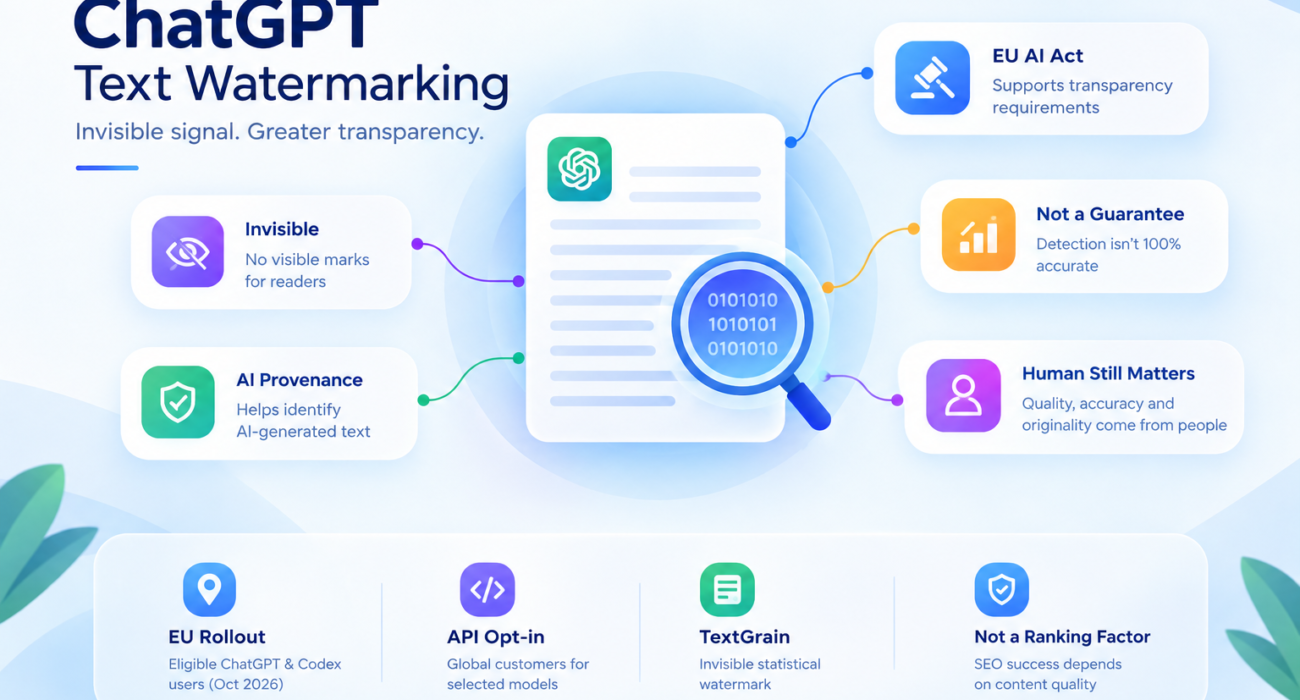
That question has gotten attention after OpenAI’s October 2026 announcement of textGrain. It’s a text watermark for ChatGPT and Codex outputs in the European Union. OpenAI is using it to meet AI transparency rules under the EU AI Act. The system helps track AI-generated text without changing how it looks.
This update is bigger than it looks. It sparks doubts about AI content detection, publishing methods, content clarity, search engine tactics, and human editing on a web that uses AI. For businesses and creators, the key point is clear: a ChatGPT watermark does not replace judgment, original ideas, or careful content creation in ensuring quality and trust for audiences.
ChatGPT Has Become Part of Modern Content Workflows
ChatGPT is no longer for answering simple questions. It helps people research, outline ideas, explain topics, and brainstorm. It summarizes content, improves writing drafts, writes code, and handles work. For content teams, it speeds up the stages of article creation. Writers can use it to organize thoughts, find key questions readers might ask, and prepare for research before finalizing the piece.
That distinction matters. There is a difference between using AI to help make content and just putting out AI-made stuff without checking it. The first can fit into an editing process. The second can cause issues if the info is wrong, repeated, old, or not original.
Google’s current guidance makes a distinction. Generative AI can be useful for daily research. Structuring efficient original content, but producing large amounts of content without adding value, can fall under its policies concerning scaled content abuse. Google also recommends reviewing AI-generated content for accuracy, quality, and relevance.
OpenAI’s TextGrain Watermarking Introduces a New Provenance Signal
OpenAI’s new technology is called textGrain. By putting a visible label or hidden characters into a reply, textGrain alters the statistical pattern of the model’s word selections. A compatible detector can then search for that pattern to decide if an OpenAI watermark is present in the given text; that OpenAI watermark’s easy to detect.
This is known as a provenance signal. The idea behind provenance is not simply to decide whether something is “AI” or “human.” It is to provide information about where content came from and whether an AI system was involved in creating it.
This is particularly relevant as AI-generated material becomes harder to distinguish from human-written material based on appearance alone.
The EU AI Act Is Behind the Latest ChatGPT Watermarking Move
The new ChatGPT watermarking system links tightly to Article 50 of the EU AI Act. I read that the European Commission tells AI makers who create text, pictures, sound, or video that any such content must carry a machine‑readable mark and must be easy to spot as made by a machine. These rules started on August 2, 2026, today.
The rules around AI content are not one-size-fits-all. The European Commission focuses on AI-generated or manipulated text that informs the public about matters of interest. It does not require labeling for everything.
For example, source code and certain machine-to-machine outputs are exempt. Also, human review and editorial responsibility can change how rules apply to public-interest content. This means ChatGPT’s watermarking rollout should not be seen as a rule. Not every AI-assisted website post needs an AI-generated” label. Context matters.
The rules are more detailed. They depend on purpose, audience, and use. So we should not assume that a watermark means all AI content must be labeled everywhere. It’s about the situation. The rules are nuanced. They are not simple.
ChatGPT Watermarks Are Invisible to Readers
A textGrain watermark is not a mark on an article. OpenAI says it does not use characters, invisible spaces, or odd punctuation. Instead, it alters word choice patterns during text generation. For a reader, watermarked and non-watermarked text appear identical. The signal is meant for software detection, not eyes. It relies on changes that only machines can spot. This method keeps content looking natural while allowing systems to verify authenticity.
This approach also explains why the technology is described as a provenance mechanism rather than a traditional “AI detector.” The method seeks a signal deliberately added during generation, not a guess, about whether a finished text was produced by AI. The method tracks the signal to spot AI origin.
AI Watermark Detection Has Important Limitations
It would be a mistake to treat a ChatGPT watermark as an AI detector. OpenAI acknowledges that text watermarking has limits, including false positives and false negatives. Shorter or highly restricted text can be harder to detect, while major rewriting, paraphrasing, or translation can weaken the signal. Detection performance can also differ among languages. Users should use caution.
Using a detector to find a watermark does not guarantee that every single sentence was written wholly by intelligence. Likewise, when a detector fails to locate a watermark, it does not confirm that a human authored the text.
Content may have been heavily edited, translated, generated before the watermark was introduced, produced using another AI system, or simply be unsuitable for detection. AI detection should therefore be treated as evidence of a signal, not as an absolute judgment, about authorship and should not be the final decision.
A ChatGPT Watermark Does Not Establish Authorship
One of the important details in OpenAI’s explanation is what textGrain does not tell you. A watermark does not identify the person who generated the content. It does not reveal their prompt or conversation, establish ownership, determine responsibility, or measure how much human creativity and editing went into the final text. It also does not verify whether the information itself is accurate.
An article starting with an AI draft but later rewritten, researched, and fact-checked shows how human effort shapes the product. A watermark might show OpenAI’s role. It doesn’t capture the full process. As AI becomes common in writing, this difference matters. The real value comes from expertise, accuracy, and editorial judgment—elements no watermark can reflect. Understanding this shift will be key.
ChatGPT Watermarking Does Not Mean AI Content Will Stop Ranking
The arrival of text watermarking should not be confused with a new Google ranking penalty for ChatGPT content. A watermark itself is not presented by OpenAI or Google as an SEO ranking factor.
The important issue for website owners is what the content contributes to the reader. Google’s current guidance emphasizes people-focused content and warns against producing content primarily to manipulate search rankings. Google’s guidance on AI also emphasizes accuracy, quality, relevance, and human review for all audiences and everyday readers.
That means the real SEO question is not: “Was ChatGPT used?” A better question is: “Does this page provide something genuinely useful that the reader could not get from a collection of generic AI-generated pages?” That difference is crucial.
AI-Assisted Content Still Needs Original Value
Using ChatGPT does not automatically make an article low quality. For example, AI can help a writer:
- organize a complicated subject
- brainstorm potential questions
- create an initial outline
- simplify technical explanations
- identify areas that require further research
- improve readability
- assist with repetitive editorial tasks
The value comes from what happens. A strong website article should add research-relevant examples, original observations, expert knowledge, useful explanations, and proper editorial judgment.
For fast‑changing topics such as AI, SEO, software, regulations, and digital marketing, verify facts with trustworthy sources before publishing because information can change quickly and errors may spread today. It is very important because generative AI can give incomplete or wrong statements. Google advises people to check the facts of AI-made content before putting it online today.
The Difference Between AI-Generated and AI-Assisted Content Matters
The conversation about ChatGPT often groups all AI writing together. It’s not the same. Some content is mostly made by AI with help. Other content uses AI for research, planning, or editing.
The final work is mostly done by people. This difference doesn’t mean all AI helps make content. It just shows AI can be part of a process. For companies, explaining this process can help keep editorial rules clear.
ChatGPT Watermarking Changes the Conversation Around Content Transparency
The main change is not the watermark. The rising importance of knowing where content comes from. As it gets easier to make AI content, people who read, publish, host, study, and regulate it need ways to see where it originates.
OpenAI says provenance is a system that can use various tools based on the type of material. Text, pictures, sound, and video are not all solved by the approach. Text is especially hard because it can be copied, rewritten, translated, shortened, and merged with writing. So provenance remains a growing technology, not an answer.
What ChatGPT Watermarking Means for SEO Teams
For SEO teams, the practical response is not to rewrite every article simply to remove signs of AI involvement. Instead, content teams should focus on building editorial processes.
A useful workflow can look like: Research → planning → AI assistance → expert input → fact‑checking → original content → human editing → final review and quality assurance daily
This method also backs the goal of modern SEO. Search visibility means more than putting a keyword in the right spots. A page must meet the reason a person looked it up, describe the topic in terms, give trustworthy facts, and finish with few unanswered questions. Modern SEO needs this for rankings and user trust daily.
This is especially crucial for websites in SEO, digital marketing, AI, software, and technology. These fields rely heavily on visibility and innovation to stay competitive.
For a marketing site like Glimmers Point, this means focusing on how AI changes affect real-world search results and business growth. Instead of just sharing news, the goal is to explain what these tech shifts really mean for websites’ content plans and online visibility. It’s about helping readers make decisions based on practical impact, not just hype.
The ChatGPT Watermark Rollout Is Currently Focused on the EU
OpenAI is not introducing textGrain as a worldwide ChatGPT default at launch. According to OpenAI, eligible ChatGPT and Codex text output will receive invisible text watermarks in the European Union over the coming weeks. The company says this rollout will cover eligible users across ChatGPT plans in the EU.
At the same time, OpenAI says API customers globally can opt in to text watermarking for selected models. OpenAI is limiting access to its text-watermark detector to approved researchers and expert groups.
The tool only reports if it finds an OpenAI watermark. It does not reveal user details, prompts, or conversations. This step- by-step rollout shows the technology is still evolving. Text provenance is not yet fully mature. OpenAI is being cautious. The goal is to ensure use as the system improves.
What Businesses Should Do With ChatGPT Content Now
Businesses can keep using ChatGPT because text watermarking is now available. A better path is to set rules for responsible AI usage and transparency within the company to protect data. Content teams should check facts, review AI drafts, add content, avoid repetition, and know when to add more details.
Businesses in the European Union must follow rules for their content and use. The European Commission says Article 50 has rules that depend on the situation, not a rule for all AI sentences. For others, the main point remains: using AI well is not the same as giving up control to AI.
The Future of ChatGPT Content Will Focus More on Provenance and Quality
ChatGPT’s text watermarking update is part of a much larger shift in how digital content is created and evaluated.
AI will continue to make content production faster. At the time, the internet needed better ways to tell where content comes from, who is responsible, and how good it is. Watermarking can help with one part of this problem: checking if an OpenAI origin signal is there.
It cannot answer everything. It cannot tell if an article is accurate or if the author knows the subject. It cannot check if a business has expertise or if the content is useful. These things still depend on people and the processes behind the published page.
For website owners and SEO professionals, the latest ChatGPT update might be the important takeaway. The future of search will not just be about whether AI created content. It will focus more on whether that content’s trustworthy, easy to understand, and useful.
FAQs About ChatGPT and Text Watermarking
Q.1. What is ChatGPT text watermarking?
Ans. ChatGPT text watermarking is OpenAI’s way of adding a statistical signal to text created by eligible models. This technology is called textGrain.
Q.2. Is the ChatGPT watermark visible?
Ans. No. The textGrain watermark is not seen by readers. It works by changing the model’s word choices in statistical ways, not by adding hidden marks or labels.
Q.3. Does ChatGPT watermarking apply worldwide?
Ans. No. Now OpenAI is rolling it out only for eligible ChatGPT and Codex outputs in the European Union. API users around the world can choose to use watermarked outputs for models.
Q.4. Does a ChatGPT watermark prove that AI wrote an entire article?
Ans. No. A watermark shows that an OpenAI system created or worked on part of the text.. It doesn’t say how much AI was used or how much human input was added.
Q.5. Does ChatGPT watermarking affect Google rankings?
Ans. No, Google does not treat a ChatGPT watermark as a factor. Google cares about content that’s helpful, accurate, relevant, and made for people. It also focuses on avoiding spam. So the presence of a watermark won’t hurt rankings.
Q.6. Can a ChatGPT watermark disappear after editing?
Ans. Yes. If the text is heavily rewritten, paraphrased, or translated, the watermark may become harder to detect. Short or tightly worded text can also be difficult to analyze
Q.7. Should businesses stop using ChatGPT for website content?
Ans. Not all. ChatGPT can help with research, planning, outlining, and editing. The final content should be accurate, original, well-reviewed, and made for real people—not just for search engines.
Q.8. Does an AI watermark replace an AI disclosure?
Ans. No. A watermark is a machine signal, while a disclosure tells users the content is AI-generated. These serve different purposes. Whether disclosure is needed depends on rules and the situation. Both can be important. They are not the same.
Conclusion
ChatGPT text watermarking is a step toward greater transparency as AI becomes part of everyday content creation. However, ChatGPT text watermarking cannot determine the quality, originality, or usefulness of an article. For businesses the stronger approach is to combine AI assistance, with expertise, fact‑checking, and meaningful content. As search continues to evolve Glimmers Point believes that useful, trustworthy, and people‑first content will remain at the heart of online visibility.