

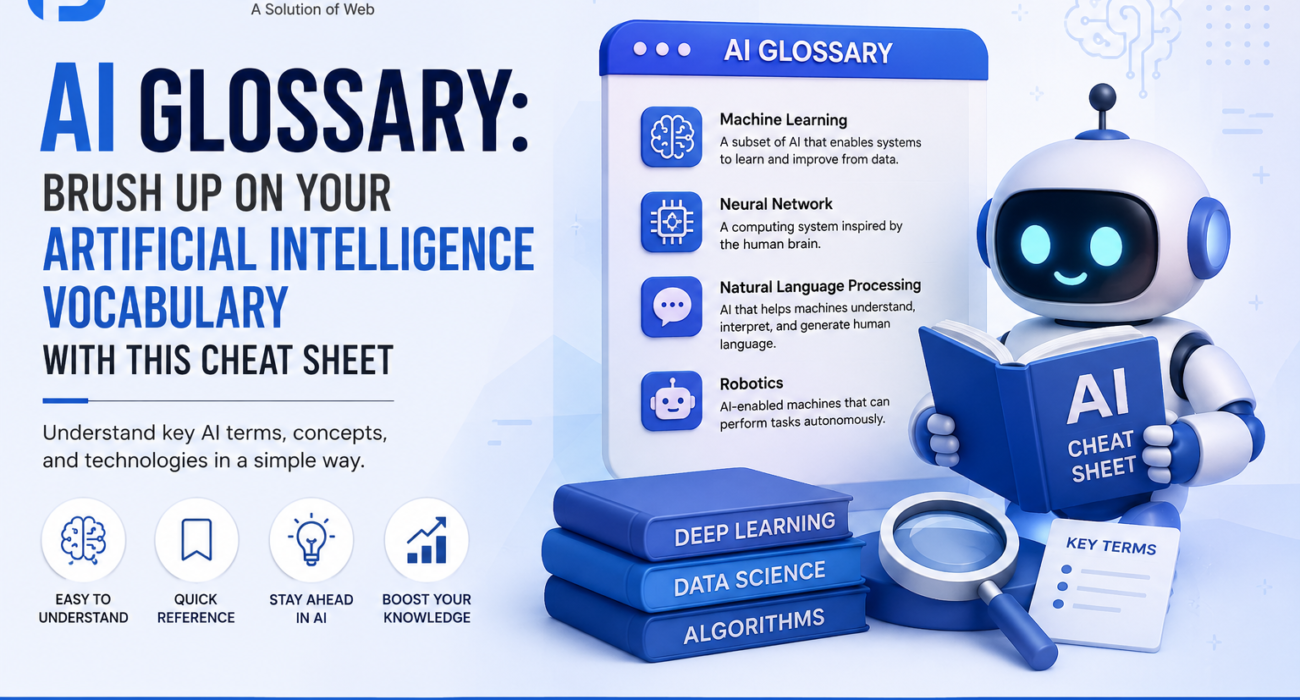
Why Every Business Owner Needs to Understand AI Terminology
AI Glossary isn’t just a buzzword anymore — it’s woven into the tools businesses use every single day, from chatbots and predictive analytics to content generation and ad targeting. Whether you’re scrolling through Instagram, asking Alexa for the weather, or wondering why your competitor suddenly outranks you on Google, AI is quietly working behind the scenes.
But if terms like “machine learning,” “natural language processing,” or “neural network” still sound like a foreign language to you, you’re not alone. Most business owners use AI-powered tools every day without ever learning the vocabulary behind them — and that knowledge gap can make it harder to make informed decisions about technology investments, marketing strategy, and digital growth.
As a digital marketing agency working with businesses across industries, Glimmers Point sees firsthand how AI is reshaping SEO, content strategy, and customer engagement. Understanding the vocabulary is the first step toward leveraging these tools effectively for your business growth. It also helps you ask smarter questions when evaluating vendors, agencies, or software — because once you understand what these terms actually mean, you can spot empty buzzwords from genuine value.
Let’s break down the essential AI terms you need to know, organized from A to Z, with practical context on how each one applies to real business decisions.
AI Glossary: A–G
Algorithm — A set of rules or instructions a computer follows to solve a problem or complete a task. Every AI system, from search engine rankings to recommendation engines, runs on algorithms. When Google decides which websites rank for a search query, it’s running thousands of algorithmic calculations in milliseconds.
Artificial Intelligence (AI) — The broader field of computer science focused on building machines that can perform tasks typically requiring human intelligence, such as reasoning, learning, problem-solving, and language understanding. AI is the umbrella term; machine learning and deep learning are subsets within it.
Big Data — Extremely large, complex data sets that are analyzed computationally to reveal patterns, trends, and associations, especially relating to human behavior and interactions. Businesses use big data to understand customer purchasing habits, website behavior, and market trends at a scale no human team could process manually.
Chatbot — An AI-powered software application designed to simulate human conversation, often used for customer service, lead generation, and support. Modern chatbots, especially those powered by generative AI, can handle complex, multi-turn conversations rather than just scripted responses.
Computer Vision — A field of AI that trains computers to interpret and understand visual information from images and videos, similar to how the human eye and brain process sight. This technology powers everything from facial recognition to automated quality inspection in manufacturing.
Deep Learning — A subset of machine learning that uses multi-layered neural networks to analyze data and make decisions, mimicking the way the human brain processes information. Deep learning is what allows AI systems to recognize images, understand speech, and generate human-like text.
Generative AI — AI systems capable of creating new content — text, images, audio, or video — based on patterns learned from training data. Tools like ChatGPT and DALL-E fall into this category, and they’re rapidly changing how businesses approach content creation, design, and customer communication.
AI Glossary: H–R
Hallucination — A term used to describe when an AI model generates information that sounds plausible but is factually incorrect or entirely fabricated. This is an important concept for businesses to understand before relying on AI-generated content without human review.
Large Language Model (LLM) — A type of AI model trained on massive amounts of text data, enabling it to understand and generate human-like language. LLMs are the technology behind tools like ChatGPT, Claude, and Gemini.
Machine Learning (ML) — A branch of AI where systems learn from data and improve their performance over time without being explicitly programmed for every scenario. ML is what allows your email inbox to get better at filtering spam the more you use it.
Natural Language Processing (NLP) — The technology that allows machines to understand, interpret, and generate human language. NLP powers everything from voice assistants and chatbots to AI content tools and sentiment analysis software.
Neural Network — A computing system inspired by the human brain’s structure, made up of interconnected nodes (“neurons”) that process information in layers. Neural networks are the foundational architecture behind most modern AI breakthroughs.
Predictive Analytics — The use of data, statistical algorithms, and machine learning to identify the likelihood of future outcomes based on historical data — is widely used in marketing to forecast customer behavior, churn risk, and campaign performance.
Prompt Engineering — The practice of crafting effective inputs (prompts) to get the most accurate, useful, or creative outputs from generative AI tools. As more businesses adopt AI tools for content and customer service, prompt engineering has become a genuinely valuable skill.
Reinforcement Learning — A type of machine learning where an AI model learns by receiving rewards or penalties based on its actions, gradually improving its decision-making over time — similar to how a person learns through trial and error.
AI Glossary: S–Z
Sentiment Analysis — An NLP technique used to determine the emotional tone behind a body of text, helping businesses understand customer feedback, reviews, and social media mentions at scale. This allows brands to quickly identify dissatisfaction trends before they escalate.
Supervised Learning — A machine learning approach where the model is trained on labeled data, learning to map inputs to known outputs. For example, an email spam filter trained on thousands of emails already labeled “spam” or “not spam.”
Training Data — The dataset used to teach an AI model how to perform its task. The quality, accuracy, and diversity of training data directly impact how reliable and unbiased the resulting AI model will be.
Turing Test — A test proposed by mathematician Alan Turing to determine whether a machine’s behavior is indistinguishable from a human’s, often used as a conceptual benchmark for measuring AI sophistication.
Unsupervised Learning — A type of machine learning where the algorithm identifies patterns and groupings in data without predefined labels or outcomes, often used for customer segmentation and anomaly detection.
Voice Search Optimization — The practice of optimizing website content to rank for voice-based queries made through AI assistants like Siri, Alexa, or Google Assistant. As voice search adoption grows, optimizing for conversational, question-based queries is becoming a critical SEO consideration.
Zero-Shot Learning — An AI model’s ability to correctly perform a task it was never explicitly trained on, by applying knowledge learned from related tasks. This is part of what makes modern generative AI models feel so flexible and capable.
How AI Is Transforming SEO and Digital Marketing
Search engines like Google now rely heavily on AI and machine learning to determine rankings, interpret search intent, and deliver personalized results. Google’s algorithms analyze hundreds of ranking factors simultaneously, using machine learning to understand not just what words are on a page, but what the searcher actually wants to find. This means understanding AI isn’t just for tech companies — it’s essential for any business that wants to stay visible online.
At Glimmers Point, our team works as dedicated SEO experts, blending data-driven strategy with the latest in AI-powered tools to help businesses rank higher, attract qualified traffic, and convert visitors into customers. As a growing digital marketing company based in India, we combine global best practices with locally informed execution — giving our clients a genuine edge whether they’re targeting a hyper-local market or scaling internationally.
Here’s how AI directly impacts the services we provide:
AI-Enhanced Keyword Research — Machine learning tools help us identify high-intent keywords and emerging search trends faster and more accurately than manual research alone, allowing us to spot opportunities before competitors do.
Content Optimization — NLP-driven tools assess readability, relevance, and search intent alignment, helping our content team craft blog posts and web pages that actually rank — and actually convert.
Predictive Performance Tracking — Predictive analytics allow us to forecast campaign performance and adjust strategy proactively rather than reactively, saving clients time and ad spend.
Smarter Customer Engagement — From AI chatbots to sentiment analysis on reviews, we help businesses use AI to better understand and serve their customers without losing the human touch that builds real trust.
Technical SEO Audits — AI-assisted crawling and analysis tools help us quickly identify technical issues — broken links, slow load times, indexing errors — that could be holding your website back from ranking well.
Common AI Myths Business Owners Should Know
As AI vocabulary becomes mainstream, so do misconceptions. A few worth clearing up:
“AI will replace all marketing teams.” In reality, AI works best as a force multiplier for skilled marketers, not a replacement. The strategy, creativity, and judgment behind a campaign still require human expertise.
“AI-generated content always ranks well.” Search engines are increasingly sophisticated at identifying low-quality, unedited AI content. The best results come from AI-assisted content that’s reviewed, refined, and aligned with genuine search intent.
“You need a massive budget to use AI tools.” Many powerful AI-driven marketing tools are now accessible to small and mid-sized businesses, making AI adoption far more achievable than most assume.
Leverage the Advantages of AI for Your Business Today
AI is no longer optional in the digital marketing world — it’s a competitive advantage. Whether you’re trying to improve your search rankings, understand customer sentiment, or simply keep up with industry jargon, having a foundational grasp of AI terminology puts you ahead of the curve.
As an experienced team of SEO experts, Glimmers Point combines deep industry knowledge with the latest AI-powered tools and strategies to deliver real, measurable results for our clients — no matter where in the world they’re based.
Ready to put an AI-powered SEO strategy to work for your business?
📞 Call: +91 98130 30336
📧 Email: Info@glimmerspoint.com
🌐 Visit: glimmerspoint.com
📍 Plot No-10, 2nd Floor, Jain Nagar, Near Galaxy Mall, Ambala City
Glimmers Point — Crafting Digital Excellence for Businesses Across India and Beyond.