

Have you ever walked past a fast food restaurant and suddenly felt hungry — even though you weren’t a minute ago?
Or chosen a brand without quite knowing why it felt more trustworthy than the competitor next to it?
That is subliminal advertising at work.
It is one of the most fascinating — and misunderstood — concepts in marketing. At Glimmers Point LLP, we believe that the best marketing does not just sell products. It speaks directly to the subconscious mind, building feelings, associations, and desires that drive decisions before the conscious brain even gets involved.
In this blog, we break down what subliminal advertising really is, how brands use it, where it has gone wrong, and what modern marketers can learn from it.
What is Subliminal Advertising?
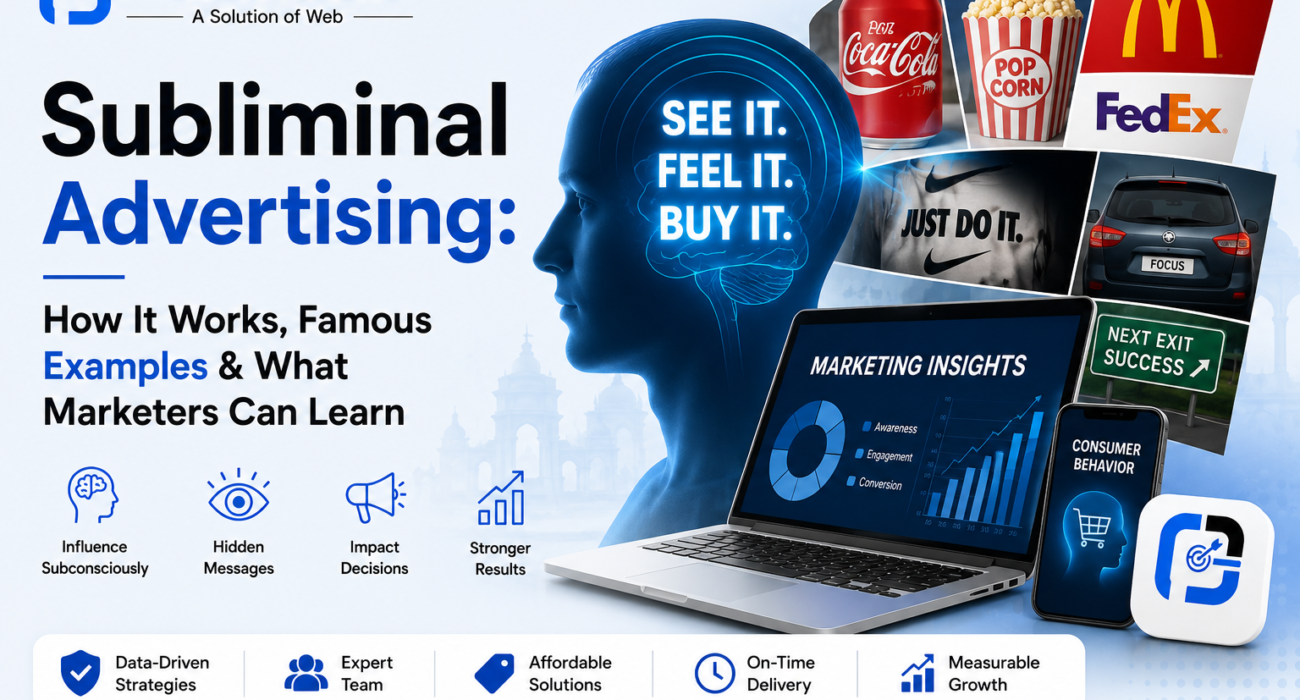
Subliminal advertising refers to marketing messages — images, sounds, words, or symbols — that are designed to influence an audience below the threshold of conscious awareness.
In simple terms, the consumer sees or hears the message, but does not consciously register it. Yet the message still shapes their feelings, preferences, and behavior.
The word “subliminal” comes from the Latin sub (below) and limen (threshold) — literally meaning “below the threshold.”
While the idea of hidden messages sounds like something out of a spy thriller, subliminal advertising is far more subtle and widespread than most people realize. It shows up in color choices, logo design, background music, image composition, and even the way products are placed on a screen.
How Does Subliminal Advertising Work?
The human brain processes an enormous amount of information every second — far more than we are consciously aware of. Our subconscious mind picks up on patterns, emotions, and associations that our conscious mind skips right over.
Subliminal advertising exploits this gap. By embedding cues into creative content, advertisers can:
- Trigger emotional responses (comfort, excitement, trust, desire)
- Create positive brand associations without direct persuasion
- Influence purchasing decisions at a subconscious level
- Build brand recall that feels instinctive rather than learned
The most effective subliminal advertising does not feel like advertising at all. It feels like a natural, emotional response.
Common Subliminal Advertising Techniques
1. Color Psychology
Colors trigger specific emotional responses. Red creates urgency and appetite — which is why McDonald’s, KFC, and Zomato all use it. Blue builds trust and calm — hence its dominance in banking and tech. Green signals health and nature. Every color choice in a brand’s identity is a subliminal decision.
2. Hidden Images & Symbols
Some brands embed subtle images or symbols within their logos or ads that are not immediately obvious. When spotted, they reinforce a deeper brand message — like the hidden arrow in the FedEx logo, pointing forward to suggest speed and precision.
3. Suggestive Imagery
Ads for food, luxury, and lifestyle products frequently use imagery that triggers desire — steam rising from food, close-up textures, aspirational settings — all designed to activate the senses subconsciously.
4. Sound & Music
Background music in ads and retail stores is carefully chosen to influence mood and behavior. Slow music makes shoppers browse longer. Upbeat music creates energy and excitement. Even the tone of a voiceover carries subliminal weight.
5. Sexual Imagery
One of the most controversial subliminal techniques — embedding subtle sexual cues into imagery to trigger primal attraction and desire toward a product. Several major brands have been caught doing this, with mixed results.
6. Strategic Product Placement
Placing a product in the hands of a beloved character, in an aspirational setting, or alongside positive imagery creates subconscious associations that viewers absorb without realizing it.
7. Word & Font Choices
Certain words, when embedded in copy or visuals, trigger specific mental responses. Bold, heavy fonts feel powerful and confident. Thin, elegant fonts feel premium and exclusive. Even the shape of letters carries subliminal meaning.
Subliminal Advertising Examples That Went Wrong
Not every attempt at subliminal messaging lands well. Here are cases where brands pushed too far:
Pepsi’s Subliminal Can (1990s)
Pepsi faced backlash when critics claimed that a pattern on their cans, when viewed at a certain angle, spelled out a competitor’s name. Whether intentional or not, the controversy was a PR nightmare.
Camel Cigarettes & Hidden Imagery
Camel’s classic “Joe Camel” campaign was accused of embedding hidden adult imagery within the cartoon character’s design. The controversy contributed to significant regulatory scrutiny of cigarette advertising.
Affordable Housing Campaign Misfire
A European housing authority ran an ad that, when frames were isolated, contained imagery completely unrelated to housing. The discovery went viral for the wrong reasons, and the campaign was pulled immediately.
The lesson: Subliminal techniques, when heavy-handed or inappropriate, can destroy brand trust overnight. Subtlety is everything.
Subliminal Advertising Examples That Worked Brilliantly
FedEx — The Hidden Arrow
The white space between the “E” and “x” in the FedEx logo forms a perfect arrow — subconsciously communicating speed, direction, and forward momentum. Most people never consciously notice it, yet it reinforces exactly what FedEx wants you to feel about their brand.
Amazon — The Smile Arrow
The arrow beneath Amazon’s logo does two things subliminally: it smiles (evoking happiness and satisfaction) and it points from A to Z (suggesting Amazon has everything). A single design element. Two powerful subconscious messages.
Toblerone — The Hidden Bear
The mountain in the Toblerone logo contains the silhouette of a bear — a nod to Bern, Switzerland (the city of bears) where the chocolate was created. A subtle detail that adds depth and heritage to the brand story.
Baskin-Robbins — 31 in the Logo
The pink portions of the “BR” in Baskin-Robbins’ logo form the number 31 — representing their famous 31 flavors. Hidden in plain sight, it rewards the observant consumer and reinforces their core brand message.
McDonald’s Golden Arches
Beyond just being an “M,” research has suggested the golden arches subconsciously resemble a symbol of comfort and nourishment. Whether by design or interpretation, the arches are one of the most recognized and emotionally charged symbols in the world.
Is Subliminal Advertising Legal?
This is a question every marketer should know the answer to.
In most countries, overt subliminal advertising — such as flashing hidden messages in video content to bypass conscious awareness — is banned. In the UK, the use of subliminal techniques designed to influence behavior without the viewer’s awareness is explicitly prohibited by the communications regulator.
However, the vast majority of what we call subliminal advertising — color psychology, logo design, music selection, imagery — operates in a legal grey zone. It is not hidden in a technical sense, but it is designed to influence below the level of conscious attention.
The line is this: influencing emotion through design is acceptable. Deliberately bypassing conscious awareness with hidden messages is not.
What Modern Marketers Can Learn From Subliminal Advertising
Whether you run a local business in Ambala or a pan-India eCommerce brand, the principles of subliminal advertising can elevate every piece of marketing you create.
Choose brand colors deliberately. Every color sends a subconscious signal. Make sure yours is sending the right one.
Design logos with intention. Great logos communicate more than a name. They tell a story, evoke a feeling, and embed a memory.
Use music and sound strategically. The background of your video ad, the hold music on your phone line, the jingle in your radio spot — all of it shapes how people feel about your brand.
Write copy that triggers emotion. Words like “imagine,” “discover,” “exclusive,” and “proven” carry subconscious weight. Use them deliberately.
Think about what your visuals are saying beyond the obvious. Every element of your creative composition, lighting, texture, and subject placement sends signals your audience processes without knowing it.
How Glimmers Point LLP Builds Brands That Connect Subconsciously
At Glimmers Point LLP, every campaign we build is designed to work on two levels — the conscious and the subconscious.
From brand identity and logo design to content strategy, social media creatives, and digital ad campaigns, we ensure that every visual, every word, and every color choice is working hard to build the right associations in your audience’s mind.
Because the brands that win are not always the loudest. They are the ones that feel right — and that feeling is built deliberately, strategically, and creatively.
📞 Call: +91 98130 30336
📧 Email: Info@glimmerspoint.com
🌐 Visit: glimmerspoint.com
📍 Plot No-10, 2nd Floor, Jain Nagar, Near Galaxy Mall, Ambala City
Conclusion
Subliminal advertising is not magic — it is psychology applied to design. The most successful brands in the world use it not to deceive, but to connect more deeply with their audiences on an emotional level.
Understanding how it works does not make you immune to it. It makes you a smarter marketer, a more intentional brand builder, and a more effective communicator.
Ready to build a brand that resonates at every level? Glimmers Point LLP is here to help.